what is needed to predict the profits for a company for the upcoming year
What is Financial Forecasting?
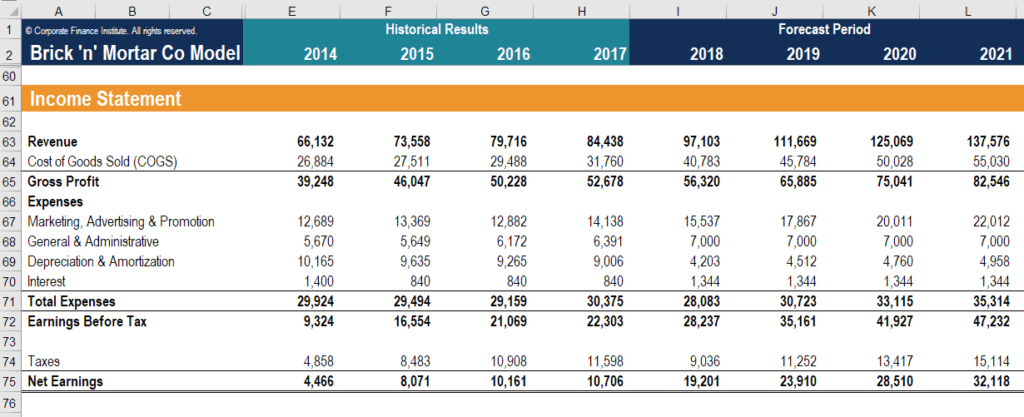
Financial forecasting is the process of estimating or predicting how a business will perform in the futurity. The most mutual type of financial forecast is an income statement; all the same, in a complete fiscal model, all 3 financial statements are forecasted. In this guide on how to build a financial forecast, nosotros will complete the income argument model from acquirement to operating profit or EBIT .
Forecasting Revenue
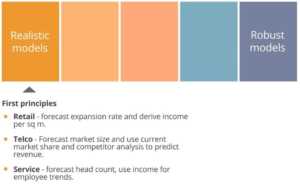
There are inherent tensions in model building between making your model realistic and keeping it simple and robust. The first-principles approach identifies diverse methods to model revenues with high degrees of detail and precision. For instance, when forecasting revenue for the retail manufacture, we can forecast the expansion rate and derive income per square meter.
When forecasting revenue for the telecommunications industry, nosotros can predict the market size and use current market place share and competitor assay. When forecasting revenue for any service industries, nosotros can estimate the headcount and use the income for client trends.
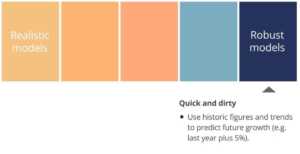
On the other hand, the quick and dirty approach to robust models outlines how you tin model revenues in a much more straightforward way, with the benefit that the model will be more simple and easy to apply (although less accurate and detailed). With this approach, users predict future growth based on historical figures and trends.
Forecasting Gross Margin and SG&A Expenses
Once nosotros cease forecasting revenues, we next desire to forecast gross margin. Gross margin is commonly forecast equally a percent of revenues. Again, we tin can use historical figures or trends to forecast futurity gross margin.
Yet, it is brash to take a more detailed approach, considering factors such as the cost of input, economies of scale, and learning bend. This 2d approach will let your model to be more realistic, but also make it harder to follow.
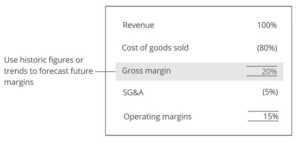
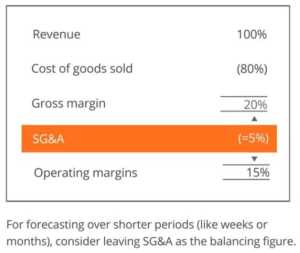
The next step is to forecast overhead costs: SG&A expenses . Forecasting Selling, General, and Authoritative costs are often done equally a percentage of revenues. Although these costs are fixed in the short term, they become increasingly variable in the long term.
Therefore, when forecasting over shorter periods (weeks and months), using revenues to predict SG&A may be inappropriate. Some models forecast gross and operating margins to get out SG&A as the balancing effigy.
Financial Forecasting Example
Let'due south go through an example of fiscal forecasting together and build the income statement forecast model in Excel. First off, you lot can meet that all the forecast inputs are grouped in the same section, chosen "Assumptions and Drivers."
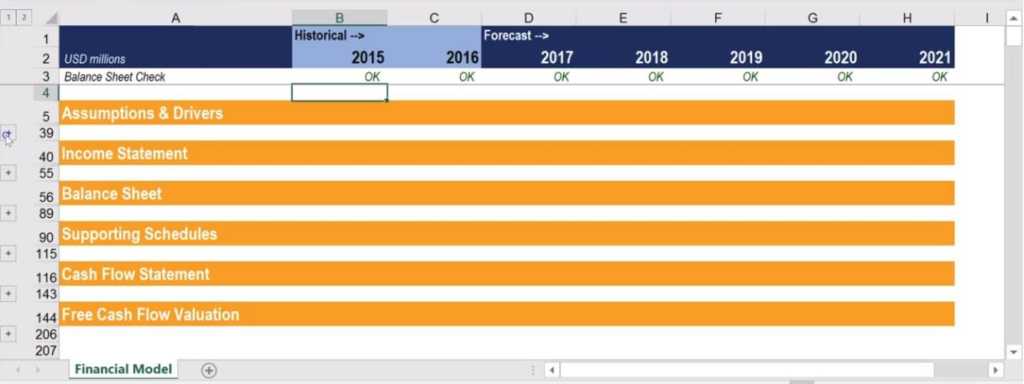
I created separate output department groups for the income statement, balance sheet, and cash catamenia argument. I also created a "Supporting Schedules" department, where detailed processing calculations for PP&E and equity are broken down in society to brand the model easier to follow and audit. In this commodity, we will simply work on the assumptions and the income statement.
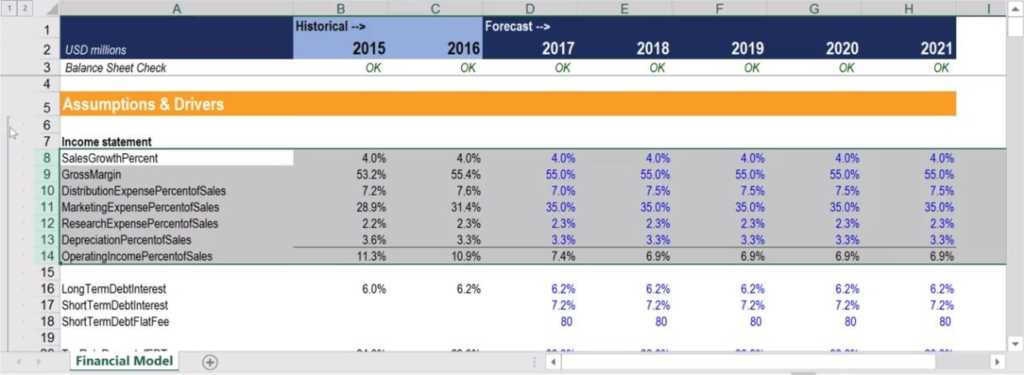
All income statement input assumptions from revenues down to EBIT tin exist institute in rows viii-14. All expenses are being forecasted equally a pct of sales. Only the sales forecast is based on growth over the previous year. My inputs are also ordered in the order they appear on the income statement.
Now, let's move to the "Income Statement" section, where nosotros are going to piece of work on Column D and motion downwards. To forecast sales for the first forecast yr (in this case 2017), I take the previous twelvemonth (C42) and grow information technology past the sales growth assumption in the "Assumptions & Drivers" section. The "SalesGrowthPercent" assumption is located in prison cell "D8". Therefore, the formula for the 2017 forecasted revenue is =C42*(1+D8).

I and so calculated our Cost of Goods Sold. To calculate the first forecast twelvemonth's COGS, nosotros put a minus sign in front of our forecast sales, then multiply by i minus the "GrossMargin" assumption located in prison cell D9. The formula reads =-D42*(1-D9).
I and then sum forecasted sales and COGS to calculate "Gross Profit", located in jail cell D44. The formula reads =SUM(D42:D43). A handy shortcut for summing is ALT + =.

Next, I forecast all the expenses in rows 45 to 48 every bit a pct of sales. Allow's start outset with "Distribution Expenses," then copy the formula down to "Depreciation." To calculate, nosotros decrease the forecast sales and multiply by the appropriate supposition, which in this case is Distribution Expense equally a Percent of Sales. The formula reads =D$42*D10. Be mindful of the $ sign because we want to make row 42 of cell D42 an absolute reference. I then re-create this formula down, using the shortcut CTRL + D or fill downward.
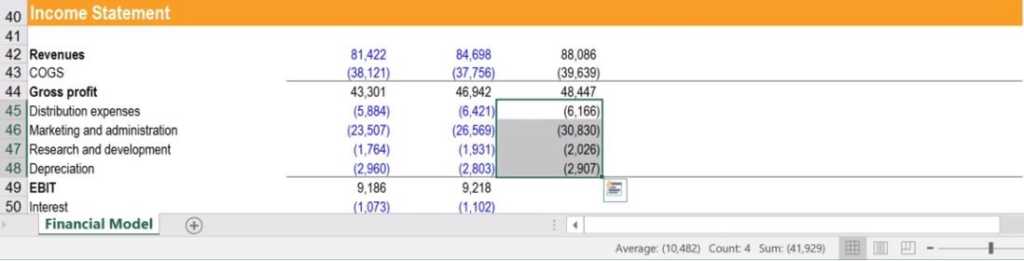
Then, over to the right, using the shortcut CTRL + R or fill right.
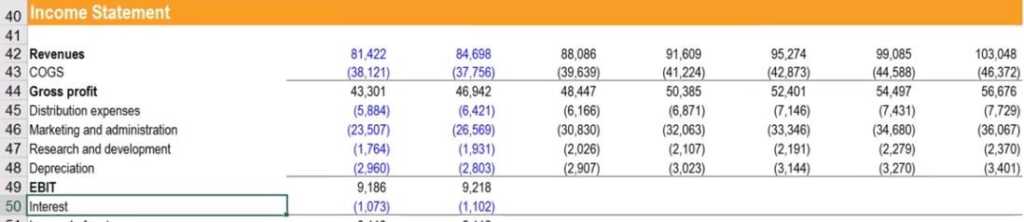
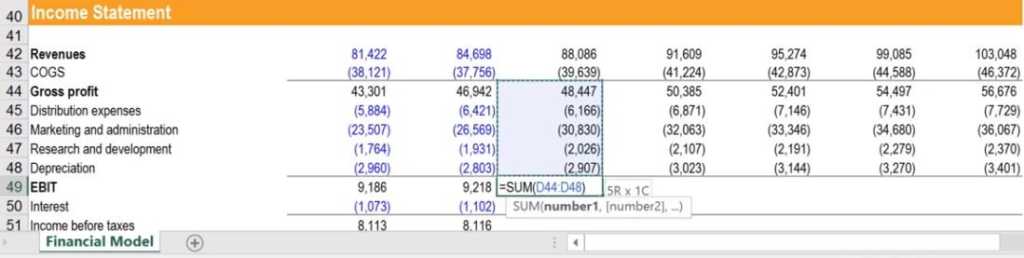
Finally, I net gross turn a profit off with all the other operating expenses to calculate EBIT, using =SUM(D44:D48).
Additional Resources
Thank you lot for reading this guide to fiscal forecasting. CFI is a global provider of financial analyst preparation and career advancement for finance professionals. To acquire more than and aggrandize your career, explore the boosted relevant CFI resource below:
- Types of Financial Models
- 3 Argument Model
- Scenario Assay
- Advanced Excel Formulas Course
Source: https://corporatefinanceinstitute.com/resources/knowledge/modeling/financial-forecasting-guide/
0 Response to "what is needed to predict the profits for a company for the upcoming year"
Post a Comment